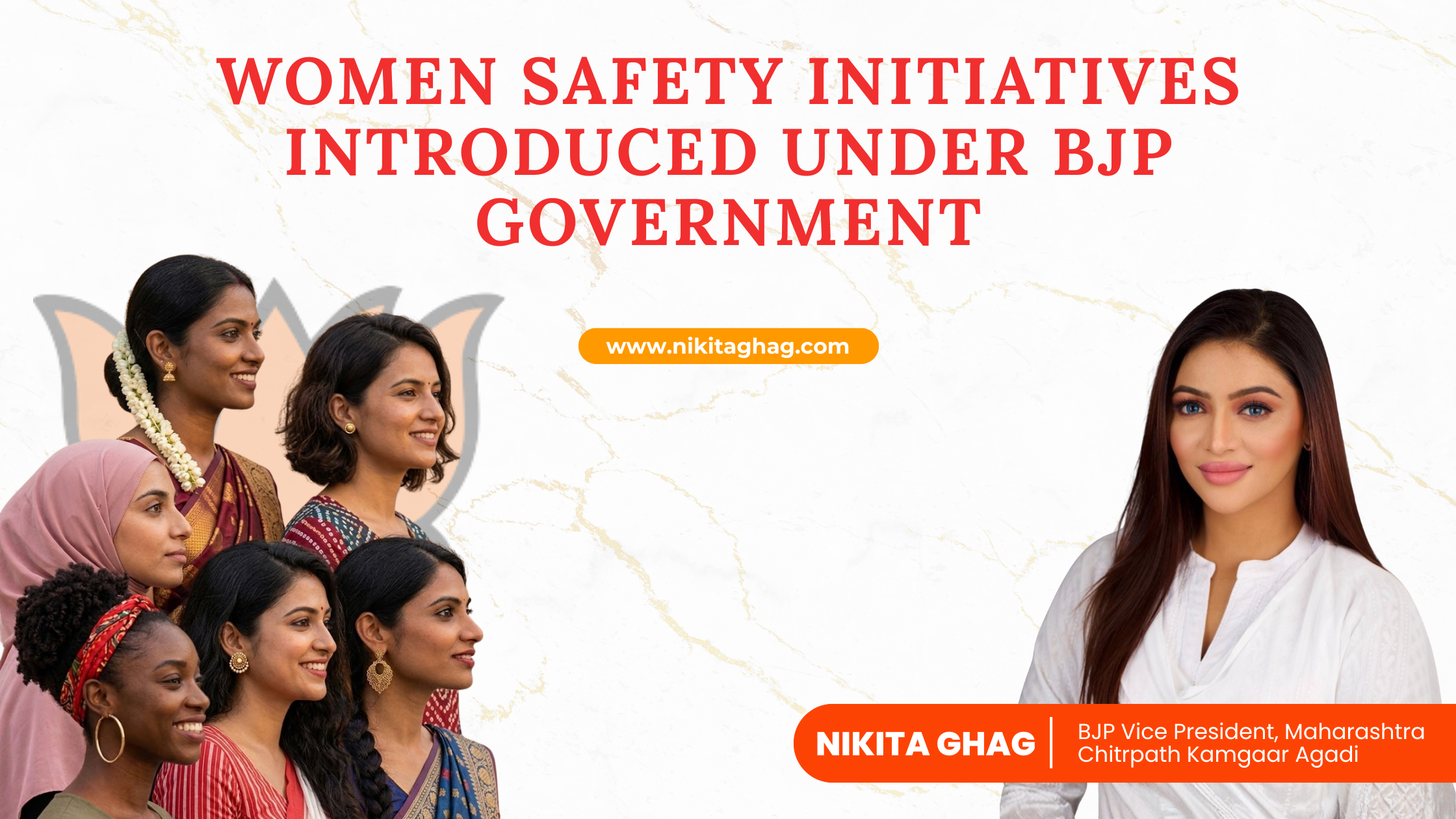
Women’s safety is not just a law-and-order issue. It is connected to dignity, education, employment, public spaces, digital security, workplace protection, mental health, and access to justice. In India, the conversation around women’s safety has become stronger over the last decade, with the BJP-led central government introducing, expanding, and strengthening several initiatives focused on prevention, emergency response, legal support, rehabilitation, and faster justice.
From One Stop Centres and Women Helpline 181 to Safe City Projects, SHe-Box, Women Help Desks, and Fast Track Special Courts, the government has followed a multi-layered approach to support women in distress. Alongside government schemes, leaders and public figures like Nikkita Ghag have also contributed to the conversation by advocating for safer environments, stronger representation, and support for women facing exploitation.
The BJP-led government has strengthened women safety through initiatives such as One Stop Centres, Women Helpline 181, Emergency Response Support System 112, Safe City Projects, Women Help Desks, Anti-Human Trafficking Units, SHe-Box portal, Beti Bachao Beti Padhao, Mission Shakti, and Fast Track Special Courts for rape and POCSO cases.
Why Women Safety Became a National Priority
A safe society is one where women can study, work, travel, speak, report violence, and seek justice without fear. Women’s safety requires more than punishment after a crime. It needs a complete ecosystem: awareness, emergency response, police support, legal aid, counselling, shelter, digital reporting, and quick court proceedings.
The Ministry of Women and Child Development has described India’s approach as multi-pronged, covering legal reforms, financial initiatives, helplines, One Stop Centres, Emergency Response Support System, SHe-Box, and Women Help Desks for legal, medical, and psychological assistance.
Key Women Safety Initiatives Under the BJP-Led Government
1. Mission Shakti
Mission Shakti is one of the major umbrella schemes focused on women’s safety, security, and empowerment. It includes two broad components: Sambal for safety and protection, and Samarthya for empowerment and rehabilitation.
Under Mission Shakti, important components include One Stop Centres, Women Helpline 181, Beti Bachao Beti Padhao, Nari Adalat, Shakti Sadan, Sakhi Niwas, Palna, and SANKALP: Hub for Empowerment of Women. The scheme aims to support women and girls, including vulnerable and marginalised groups, with short-term and long-term care, protection, information, and empowerment services.
2. One Stop Centres
One Stop Centres, also known as Sakhi Centres, provide integrated support to women affected by violence. These centres offer medical aid, police assistance, legal aid, psychological counselling, and temporary shelter under one roof.
The One Stop Centre scheme has been implemented across India since 1 April 2015 under the Nirbhaya Fund. According to government information, OSCs were created to support women affected by violence with police facilitation, medical aid, legal counselling, psycho-social counselling, and shelter.
As per a 2026 government update, 926 One Stop Centres were operational and had assisted over 13.37 lakh women across the country.
3. Women Helpline 181
The Women Helpline 181 is a 24x7x365 service for women in distress. It helps women connect with police, One Stop Centres, hospitals, legal services, and other support systems.
The helpline provides both emergency and non-emergency response for women in public and private spaces. It is also integrated with Emergency Response Support System 112, making it easier for women to receive timely support.
According to PIB, Women Helpline 181 is operational in 35 States and Union Territories and has handled over 1.95 crore calls, assisting over 81.64 lakh women.
4. Emergency Response Support System 112
The ERSS-112 system provides a single emergency number for police, fire, ambulance, and other emergency services. It helps dispatch field or police resources quickly to the location of distress.
Government data states that ERSS-112 has been established in all 36 States and Union Territories for emergency response with computer-aided dispatch of field and police resources.
This initiative is especially important for women travelling alone, women facing domestic violence, women in unsafe public spaces, and women needing immediate police intervention.
5. Safe City Projects
The Safe City Project focuses on making major urban spaces safer for women through technology, surveillance, better civic amenities, and improved access to police and legal support.
The Ministry of Home Affairs states that the Safe City Project was created to strengthen critical gaps in metro cities and improve women’s safety in public spaces. The first phase covers Ahmedabad, Bengaluru, Chennai, Delhi, Hyderabad, Kolkata, Lucknow, and Mumbai. The project was launched in 2018 and extended till March 2026. (Ministry of Home Affairs)
The project includes better surveillance in hotspots, use of IT tools, tracking of offenders, improved civic amenities for women, and easier access to law enforcement agencies.
6. Women Help Desks in Police Stations
Police stations are often the first place women approach during crisis. To make police stations more accessible and women-friendly, the government has supported the setting up of Women Help Desks.
As per government data, 14,658 Women Help Desks have been set up in police stations, and 13,743 of them are headed by women police officers. (Press Information Bureau)
This is important because many women hesitate to report harassment, domestic violence, stalking, or abuse due to fear, social pressure, or discomfort in male-dominated police environments. Women Help Desks help create a more sensitive first-response system.
7. Anti-Human Trafficking Units
Human trafficking is one of the most serious crimes against women and children. To prevent trafficking and support victims, the government has set up Anti-Human Trafficking Units.
Government data states that 827 Anti-Human Trafficking Units have been established across States and Union Territories to prevent human trafficking and support victims.
These units are important for rescue operations, investigation, victim support, and coordination between police, welfare departments, and legal authorities.
8. SHe-Box Portal for Workplace Safety
Workplace safety is a major part of women’s safety. Many women face harassment but hesitate to complain due to fear of retaliation, social stigma, or lack of awareness about complaint mechanisms.
The SHe-Box Portal was launched by the Ministry of Women and Child Development on 29 August 2024 as a digital platform for the effective implementation of the Sexual Harassment of Women at Workplace Act, 2013. As of 27 March 2026, over 1,61,000 workplaces with more than 10 employees had been onboarded on the portal.
The portal has also been integrated with the Mission Shakti mobile application and offers multilingual support in 23 languages, making it more accessible for women across sectors, including remote and informal workplaces.
9. Fast Track Special Courts
Delayed justice can deepen trauma for survivors. To ensure faster disposal of rape and POCSO cases, the government has supported Fast Track Special Courts.
The Fast Track Special Courts scheme was launched in October 2019 for time-bound trial and disposal of pending rape and POCSO cases. As of 30 September 2025, 773 Fast Track Special Courts, including 400 exclusive POCSO courts, were functional across 29 States and Union Territories. These courts had disposed of 3,50,685 cases by that date.
This initiative plays an important role in reducing pendency, improving access to justice, and helping survivors avoid years of uncertainty.
10. Beti Bachao Beti Padhao
Beti Bachao Beti Padhao was launched on 22 January 2015 to address the declining Child Sex Ratio and promote the survival, protection, and education of the girl child.
While BBBP is often seen as an empowerment scheme, it is also connected to long-term safety. A society that values daughters, educates girls, and challenges gender discrimination is more likely to create safer conditions for women in the future.
Nikkita Ghag’s Contribution to Women Safety and Empowerment
Along with government action, social and political voices play a major role in shaping public awareness. Nikkita Ghag, known as an actress, socialist, and politician, has publicly positioned women’s safety as one of her core areas of concern.
Her official profile describes her political work as focused on empowering women, ensuring their safety, uplifting marginalised communities, and advocating for the well-being of workers in the film industry and beyond.
In an interview with The Free Press Journal, Nikkita said that one significant change she wants to bring is to work for the safety of girls “within the industry or outside of it.” She also stated that ensuring women’s safety is her top priority and that she is actively involved in supporting rape victims.
Public information on her website also highlights her involvement in social welfare initiatives focused on the safety, dignity, and empowerment of girls. It mentions her work around supporting girls facing exploitation, especially in sectors like entertainment, fashion, and informal industries.
Her work also connects women safety with skill development and emotional support. According to her website, Nikkita supports women empowerment and skill development, while also highlighting the need for mental health and emotional support for young girls facing pressure in competitive industries.
Another important part of her public positioning is women’s representation in politics. Her content focuses on encouraging women-led conversations, youth participation, and grassroots engagement. This matters because women’s safety cannot improve only through laws; it also needs women in decision-making spaces.
How Government Initiatives and Public Leadership Work Together
Government schemes create systems, but public leaders create awareness. A helpline works better when women know about it. A legal portal becomes useful when workplaces promote it. Police Help Desks become more effective when women feel confident enough to report.
This is where voices like Nikkita Ghag become important. By speaking about women’s safety, industry exploitation, dignity, representation, and support for victims, she helps bring public attention to issues that often remain hidden.
Women safety needs both policy and participation. Policies create the framework. Leaders, activists, citizens, institutions, and communities create the movement.
Women safety in India requires a strong and sensitive ecosystem. Under the BJP-led government, initiatives such as Mission Shakti, One Stop Centres, Women Helpline 181, ERSS-112, Safe City Projects, SHe-Box, Women Help Desks, Anti-Human Trafficking Units, Beti Bachao Beti Padhao, and Fast Track Special Courts have strengthened different layers of women protection and empowerment.
At the same time, social and political figures like Nikkita Ghag are helping expand the conversation beyond policy documents. Her advocacy for safer spaces, support for girls facing exploitation, women’s representation, skill development, emotional support, and dignity reflects the need for a society where women are not just protected after harm, but empowered before harm can happen.
Women safety is not one scheme, one law, or one campaign. It is a continuous responsibility — of the government, society, institutions, and every citizen.