
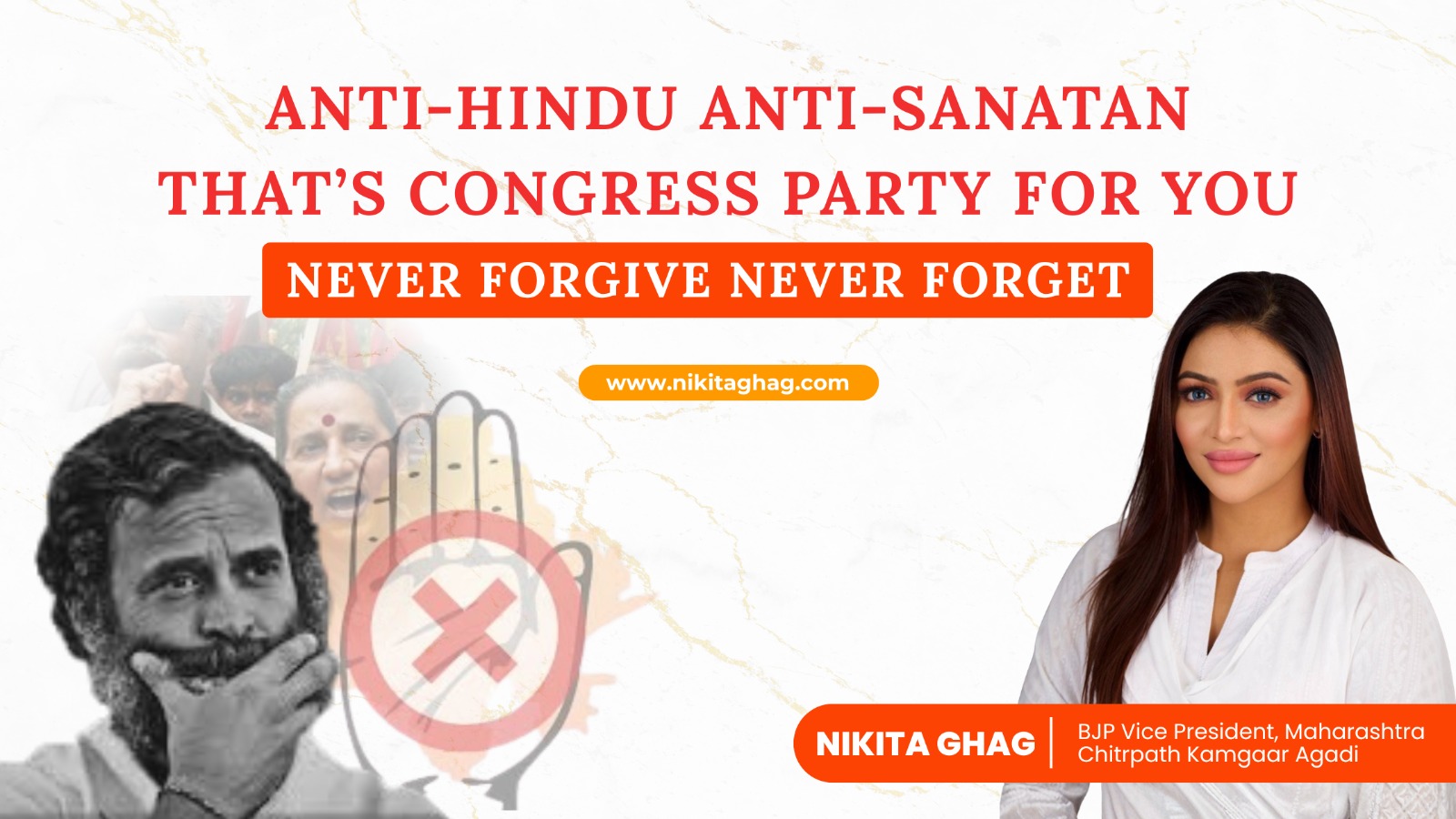
In the sacred land of Maharashtra—the land of Chhatrapati Shivaji Maharaj and Sant Tukaram—our culture is not just a practice; it is our soul. But today, a dark cloud of appeasement politics looms over our heritage. As we look at the political landscape of 2026, one truth stands out clearer than ever: the Congress Party’s anti-Hindu, anti-Sanatan mindset is no longer a secret. It is a calculated strategy.
A powerful narrative has taken center stage: the alleged anti-Hindu and anti-Sanatan stance of the Congress Party. The digital and physical corridors of the nation are buzzing with a singular sentiment—Never Forgive, Never Forget.
For millions of devotees and citizens, the “Grand Old Party” appears to be drifting further away from the cultural and spiritual ethos that defines India. But is this just political rhetoric, or is there a pattern of behavior that justifies these labels?
The “Anti-Sanatan” Pattern: A Timeline of Disconnect
Recent years have seen a series of statements and policy decisions from Congress leadership that many perceive as direct attacks on Sanatan Dharma.
- Mocking Rituals: From questioning the existence of Lord Ram to labeling our peaceful traditions as divisive, the Congress has consistently prioritized a specific vote bank over the sentiments of a billion Hindus. Most recently, in early 2025, BJP leaders slammed Congress chief Mallikarjun Kharge for his comments regarding the Maha Kumbh. By questioning the efficacy of a holy dip in the Ganga, Kharge was accused of dismissing a tradition held sacred by millions for millennia.
- The “Eradicate Sanatan” Rhetoric: The shadows of the 2023 controversy, where alliance partners called for the “eradication” of Sanatan Dharma, continue to haunt the party. The perceived silence or tepid defense from Congress leadership has led many to believe that the party’s ideological shift is now permanent.
- Interference in Traditions: From the coastal belts of Karnataka to the hills of Tamil Nadu, local Congress units and their allies have been accused of suppressing Hindu traditions—whether it’s restricting temple festivals or challenging age-old practices like the lighting of the Deepam.
- Targeting Traditions: Recently, we’ve seen attempts to suppress traditional festivals under the guise of “regulations,” while other religious activities are given a free pass.
- The Vande Mataram Insult: How can a party that claims to represent India fund events where slogans are raised against the very essence of Bharat Mata?
Appeasement Politics vs. Equal Respect
A core grievance among the electorate is the perceived double standard in the party’s approach to secularism.
| Feature | Congress Approach (Perceived) | The Public Demand |
| Hindu Festivals | Often questioned or restricted under administrative pretexts. | Unhindered celebration of cultural heritage. |
| Minority Outreach | Proactive policy making and defense of traditions. | Fair and equal treatment for all religions. |
| Sanatan Dharma | Viewed through a lens of social critique. | Respected as the foundational civilization of India. |
Prime Minister Modi and other leaders have frequently pointed out that while the Congress seeks to introduce laws that favor specific vote banks—such as the recent debates over communal violence bills in Assam—they remain “allergic” to the symbols of Hindu pride.
Why the Youth Say: “Never Forgive, Never Forget”
The modern Indian voter is more connected and culturally aware than ever before. Social media has become a repository of every statement made against the Hindu faith.
- Digital Memory: Clips of leaders mocking “Shakti” or questioning the existence of Lord Ram are shared instantly. In 2026, these are not just memories; they are digital receipts.
- Cultural Assertion: There is a growing movement to reclaim the Indic identity. Any party seen as an obstacle to this reclamation faces a steep uphill battle.
- Policy Bias: The questioning of the Supreme Court’s stance on SC status for converts has further fueled the narrative that Congress prioritizes expansionist religious interests over the indigenous social fabric.
The slogan “Never Forgive, Never Forget” isn’t just a hashtag; it’s a commitment to our ancestors. When the Congress party questions the Maharashtra Freedom of Religion Act or tries to paint a “saffron terror” narrative, they aren’t just attacking a political opponent—they are attacking you, your family, and your history.
Maharashtra Won’t Be Silenced
As a Politician in Maharashtra and a proud worker of the BJP, I, Nikita Ghag, see the impact of this “divide and rule” policy every day. The people of Maharashtra are observant. They see the anti-conversion laws being opposed by the opposition. They see the reluctance to celebrate our history in school textbooks.
“To forget the insults to our Dharma is to invite the destruction of our future. We must remember who stood with us and who tried to dismantle our identity.”
Conclusion: The Road Ahead
For the Congress Party to regain its footing, it must address the “anti-Hindu” tag not with PR stunts, but with a genuine realignment with the country’s cultural roots. Until then, the hashtags #AntiHinduCongress and #NeverForgiveNeverForget will continue to trend, serving as a reminder that the soul of India is no longer willing to be sidelined.
Why Support Matters Now
Under the leadership of the BJP in Maharashtra, we are fighting to ensure that our temples are protected, our workers are empowered, and our Sanatan values are passed down to the next generation. We don’t just talk about culture; we live it.
Join the movement. Stand for Sanatan. Stand for Maharashtra.